Cordierite Honeycomb Monolith
Ceramic Substrates Built for Coating and Converter Production
Flow-through cordierite substrates in 100–900 CPSI, supplied in round, oval, runway and custom profiles for automotive, motorcycle, diesel and industrial emission-control applications.
100–900 CPSI
Uncoated or Coated
Custom Dimensions
SO 9001:2015
Integrated Production
Extrusion, drying, firing and inspection
Low Thermal Expansion
CTE below 1.2×10⁻⁶/°C
Flexible Geometry
Round, oval, runway and custom profiles
Lot Inspection
Dimensions, appearance and physical properties
Product Range
Choose the Geometry That Fits Your Converter Package
Standard tooling covers the most common converter profiles. Custom cross-sections can be evaluated from your drawing, target dimensions and required cell density.
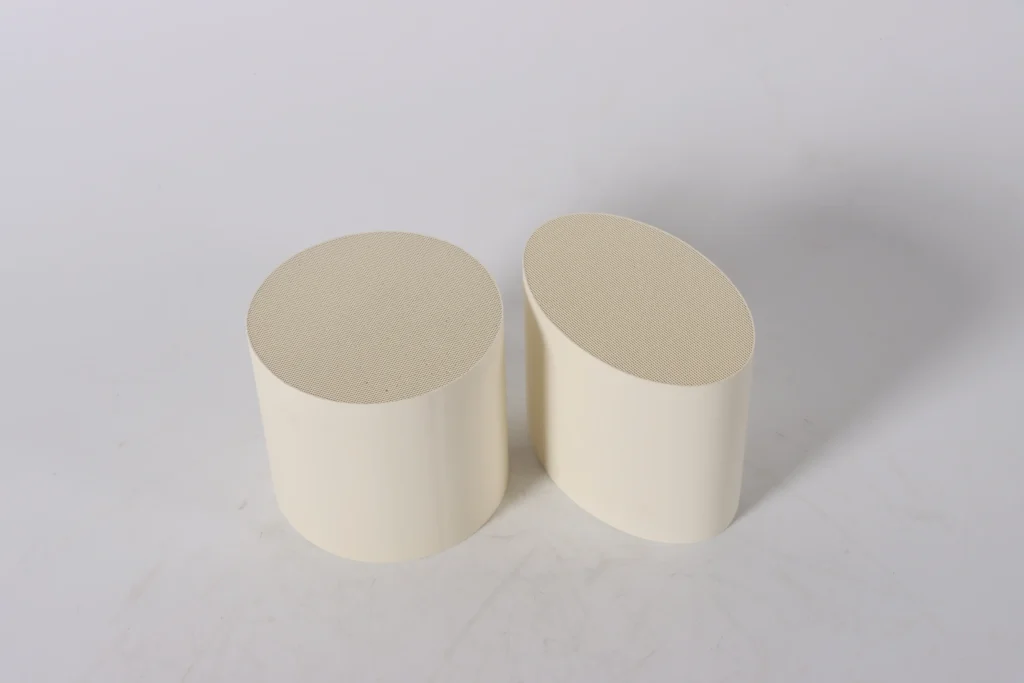
Standard Profile
Round Ceramic Substrate
Widely used in passenger vehicles, motorcycles, diesel oxidation catalysts and stationary exhaust systems.
- Broad tooling availability
- Suitable for multiple CPSI options
- Easy integration into cylindrical shells
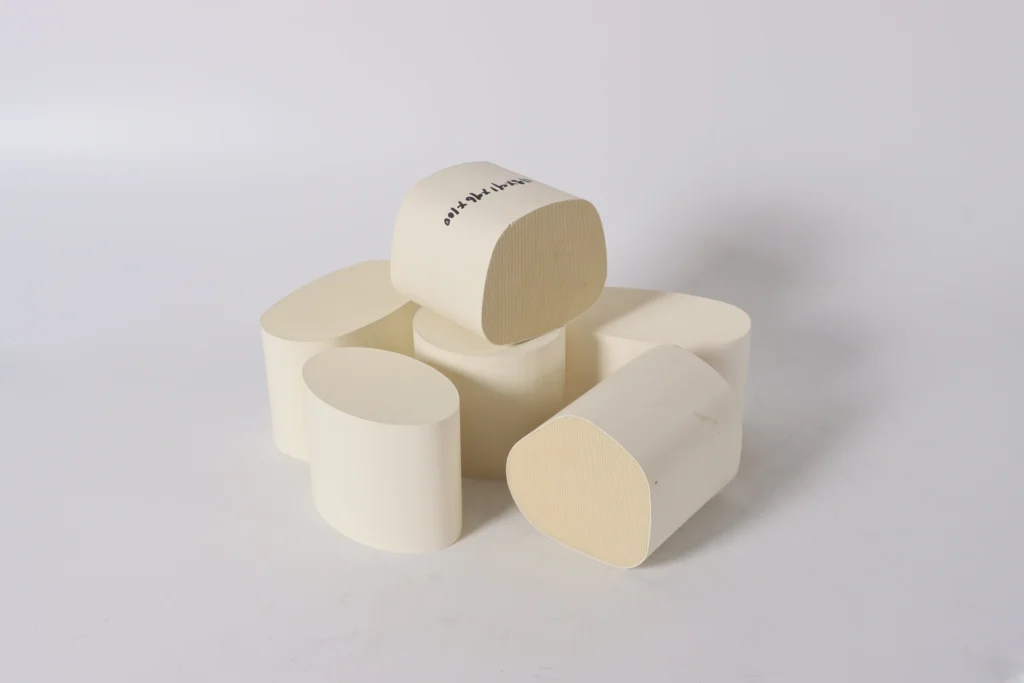
Space-Saving Profile
Oval Ceramic Substrate
Designed for converter packages where installation height or underbody clearance is restricted.
- Compact cross-section
- Common in close-coupled systems
- Dimensions confirmed by drawing
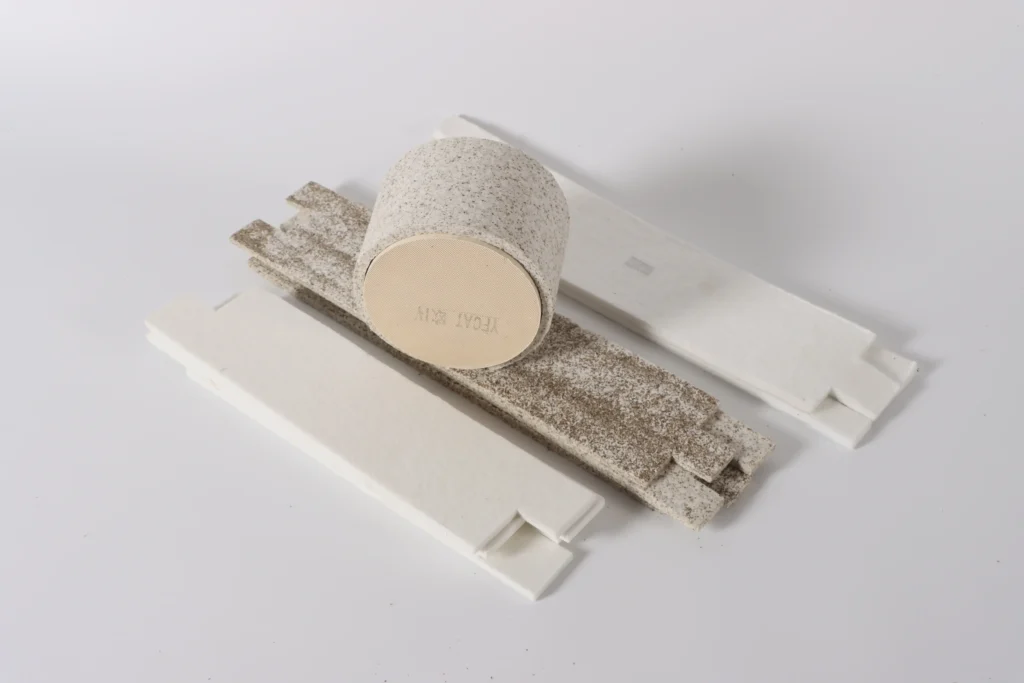
Custom Profile
Runway and Rectangular Substrate
For non-circular housings, industrial units and custom converter designs requiring a specific package envelope.
- Runway and rectangular options
- Custom die feasibility review
- Prototype and volume requirements assessed separately
Application Guide
Start With Flow Rate, Package Size and Emission Duty
CPSI selection is a trade-off between geometric surface area and exhaust back pressure. The figures shown are common starting points, not a final engineering specification.
Final selection should be confirmed against engine displacement, exhaust flow, catalyst loading, target conversion performance and allowable pressure drop.
Gasoline Passenger Vehicle
Three-way catalyst and aftermarket converter production
400–600 CPSI
Typical range
TWC
Motorcycle and Small Engine
Compact package with moderate exhaust flow
200–400 CPSI
Typical range
TWC / Oxidation
Diesel DOC and SCR Carrier
Higher flow systems where pressure drop is critical
200–400 CPSI
Typical range
DOC / SCR
Generator and Industrial Exhaust
Continuous-duty and high-volume gas treatment systems
100–300 CPSI
Typical range
Oxidation / SCR
Wall-Flow DPF Applications
Requires plugged-channel filter structure rather than standard flow-through substrate
200–300 CPSI
Typical range
Cordierite / SiC DPF
Technical Data
Core Ceramic Substrate Specifications
A concise view of the parameters most buyers need for initial technical matching. Final tolerances and inspection requirements are confirmed in the approved datasheet or drawing.
| Material | Cordierite ceramic (2MgO·2Al₂O₃·5SiO₂) |
|---|---|
| Cell Density | 100, 200, 300, 400, 600 and 900 CPSI |
| Available Shapes | Round, oval, runway, rectangle and reviewed custom profiles |
| Typical Length Range | 50–200 mm; other lengths reviewed on request |
| Wall Thickness | Approximately 2.0–6.5 mil, depending on CPSI and tooling |
| Coefficient of Thermal Expansion | ≤ 1.2 × 10⁻⁶/°C, room temperature to 800°C |
| Softening Point | ≥ 1400°C |
| Water Absorption | 25 ± 2% |
| Porosity / Mean Pore Size | 40–50% / 12–18 μm |
| Compression Strength | A-axis ≥ 10 MPa; B-axis ≥ 3.0 MPa; C-axis ≥ 2.0 MPa |
What to Send for a Fast Review
A complete inquiry reduces repeated confirmation and allows tooling, specification and quotation checks to happen together.
Drawing or exact dimensions
Diameter or cross-section, length and tolerance.
Required CPSI and wall thickness
Or provide the current substrate specification.
Application and catalyst type
TWC, DOC, SCR, oxidation catalyst or DPF.
Trial and forecast quantity
Initial order plus expected monthly demand.
Coating requirement
Uncoated substrate or catalyst-coated supply.
Designed Around the Requirements of
Coating and Canning
The substrate must support coating uniformity, withstand handling and canning loads, and remain stable under exhaust thermal cycling.
Controlled Flow Resistance
Consistent channel geometry and wall thickness help control pressure drop across the substrate face.
Thermal Shock Resistance
Low thermal expansion supports stability during rapid heating and cooling cycles in exhaust service.
Coating-Compatible Porosity
Controlled water absorption and pore structure support washcoat uptake and adhesion.
Mechanical Stability
Compression strength is controlled for handling, mat mounting, shell assembly and in-service vibration.
From Ceramic Batch to Finished Monolith
The production chain is managed in-house so material preparation, forming, firing and inspection can be controlled as one process.
Material Preparation
Cordierite-forming raw materials are weighed, blended and prepared for extrusion.
Honeycomb Extrusion
Selected dies form the required profile, CPSI and wall structure.
Controlled Drying
Moisture is removed under controlled conditions to reduce deformation and cracking.
High-Temperature Firing
The ceramic structure develops its final phase, strength and thermal properties.
Inspection and Packing
Finished parts are checked, separated by lot and protected for shipment.
Dedicated Manufacturing Facility
Integrated equipment and process control support standard production and custom substrate development under an ISO 9001:2015 quality system.
Dimensional inspection against approved drawing
Visual checks for cracks, chips and contamination
Lot sampling for water absorption and strength
CTE verification according to sampling plan
Traceable inspection records by production lot
Protective packing based on substrate size and quantity
One Supplier, More Options
Extend the Substrate Into a Complete Emission-Control Solution
Buy the ceramic core only, add catalyst coating, or discuss a complete converter assembly according to your manufacturing stage.
Alternative Carrier
Metal Substrate
Fe-Cr-Al metallic honeycomb for applications requiring thin walls, rapid light-off or higher thermal conductivity.
Value-Added Service
Catalyst Coating
Fe-Cr-Al metallic honeycomb for applications requiring thin walls, rapid light-off or higher thermal conductivity.
Complete Product
Converter Assembly
Substrate, mat, shell and inlet/outlet components integrated into a converter unit built to your specification.
Frequently Asked Questions
Questions Buyers Commonly Ask
Final specifications are confirmed against your drawing, application and testing requirements.
How do I choose the right CPSI?
CPSI is selected by balancing catalyst surface area and allowable back pressure. Passenger-car TWC applications commonly begin at 400–600 CPSI, while larger diesel and industrial systems often use 100–400 CPSI. Final selection should be reviewed against exhaust flow, catalyst loading and performance targets.
Can you manufacture a size that is not in your standard range?
Custom dimensions and profiles can be evaluated. Send a drawing showing the cross-section, length, tolerance, CPSI and expected quantity. We will confirm whether existing tooling can be used or a new die is required.
Can the substrate be supplied with catalyst coating?
Yes. Substrates can be supplied uncoated or with TWC, DOC, SCR or DPF catalyst coating, subject to formulation and application review. Coating requirements should be included in the initial inquiry.
Is a DPF substrate the same as a standard ceramic substrate?
No. A standard catalyst carrier uses open flow-through channels. A DPF uses a wall-flow structure with alternating channels plugged at opposite ends to trap particulate matter. Cordierite and SiC DPF options should therefore be specified separately.
What determines the minimum order quantity?
MOQ depends on whether your specification matches existing tooling and regular production. A custom profile, unusual CPSI or new die usually requires a different setup and quantity review. Send both the trial quantity and expected ongoing volume for assessment.
Request a Technical Review
Send Your Drawing, Size or Current Substrate Specification
We will review geometry, CPSI, coating requirements and tooling feasibility before preparing the quotation.
- Technical response typically within 1–2 business days
- Standard tooling and custom die feasibility reviewed
- Uncoated, coated and complete assembly options available
Ceramic Substrate Inquiry
Share the core specifications below for an initial review.